Alan and Don have been part of the Upper Rainier Beach Garden Tour for the last 11 years. After a virtual tour in 2020 due to the pandemic, they were thrilled to participate in person again this year. Enjoy these highlights…
A backyard perineal bed.
Alan & Don’s DIY pond is home to several Koi that are more than 20 years old. They dug the pond 5-feet deep and brought in 6 1/2 tons of rock to construct the pond. They did all the labor themselves.
Young Fir cones on a potted conifer.
An overhead view of the stream leading into Alan & Don’s beautiful backyard pond.
COVID Status: King County is currently in Phase 3 of the state’s Healthy Washington Roadmap to Recovery plan. Phase 3 allows for additional indoor activities, including indoor dining at 50 percent capacity. For more information, go here.
Recommendation: If you are looking for a place for a delicious breakfast or lunch, I recommend giving Both Ways Café a try.
Background: Both Ways Café is located right across the street from the Windermere Mount Baker office, so I’ve been going there for many years. The food and service keeps me coming back. They’re open for breakfast and lunch, and there is plenty of street parking nearby. They’re currently doing takeout and outside seating under their tent with a heater, if needed.
Location: Both Ways Café sits at the east end of Genesee Street, just two blocks from Lake Washington in the Mount Baker neighborhood of southeast Seattle.
Atmosphere: Both Ways has a fun, eclectic atmosphere. It’s cozy and comfortable with rotating art on the walls and display cases of their fresh baked goods. The best addition to the space is the ample outdoor seating areas that are mostly all shaded and very pleasant this time of year.
Food: I’ve tried many things at Both Ways, but my favorites are the Northwest Scramble (wild king salmon, scrambled with scallions, mushrooms, fresh spinach and cream cheese) & the Spinach Havarti Scramble (Danish Havarti Cheese scrambled with spinach). Their warm biscuits are amazing! I have had almost all of their sandwiches for lunch and never had one that I didn’t like. They also have a big selection of freshly baked pastries. Their portions are huge, but they do offer half orders, which is what I usually get.
Bonus: They bake their own bread, so it is always fresh and delicious.
Getting pre-approved is a great first step for buyers, but there can be a number of hurdles in the process. Here are a few cautionary steps that can be taken to make the experience as smooth and worry-free as possible.
Pre-Approval
Getting pre-approved has many benefits for buyers: it strengthens their buying power, assists in identifying their price range, helps communicate their preparedness to sellers, and, once their offer is accepted, helps to speed up the closing process.
Pre-approval is broken down into two steps: pre-qualification and pre-approval. During pre-qualification, buyers will share their financial information with their bank or lender to understand the approximate loan amount they can expect to qualify for. The pre-approval process is a little more involved, as the lender will conduct a thorough review of the buyer’s financial health to give them a more detailed picture of how much they can borrow, estimated monthly costs, and what interest rate they can expect on their loan.
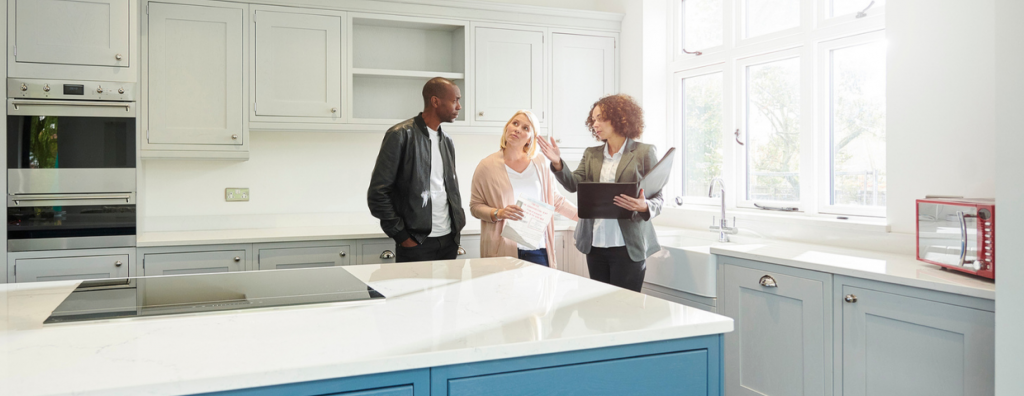
Image Source: Getty Images
Mistakes to Avoid After Pre-Approval
Being pre-approved doesn’t mean buyers are all set. There are certain mistakes that can throw buyers off course, and in some cases, lead to a denial of financing. Here are five common mistakes that can do just that:
Large Purchases
Any large purchases—credit or cash—made after getting pre-approved can easily cause trouble for buyers. Making a large credit purchase equates to increasing debt, which raises a buyer’s debt-to-income ratio. Large cash purchases decrease a buyer’s cash-readiness from the time when they were pre-approved. In both scenarios, the lender may call into question a buyer’s ability to make their mortgage payments.
Quitting or Changing Jobs
Knowing that a buyer has a stable source of income is important to lenders. Accordingly, it is best for a buyer to wait until after the home loan process is complete before taking steps to change their employment. Not only could changing jobs potentially put their mortgage pre-approval at risk, but it could also delay their settlement, since it takes time to prove a new salary.
Unpaid Bills
Missing bill payments can be especially harmful to a buyer’s candidacy in the time between getting pre-approved and closing on the home. During pre-approval, lenders are using your ability to pay bills on time to help them paint a picture of your finances and it’s important to keep that picture consistent.
New Credit
Opening new credit accounts will likely change a buyer’s credit score, which may cause adjustments in their interest rate. Lenders, upon seeing a new line of credit, even a store credit card, may elect to review the buyer’s risk of non-payment.
Paying Off Debt
While most people would think paying off debt is a good thing, if a buyer pays off any significant loans or credit card debt after pre-approval, their lender will want to know where the money came from. The decrease in debt will also have an effect on the buyer’s debt-to-income ratio, which may alter their creditworthiness.
The period of time between pre-approval and closing on a home can be a tedious one for buyers. Before making any significant financial decisions, it’s helpful for buyers to speak with their lender to get an idea of how it may impact their financial standing. The complexities of this process also highlight the importance of working with an experienced agent.
Summer is the season of spending long days and nights out in the backyard and making home-cooked meals on the barbecue. Whether classic BBQ dishes like ribs and hamburgers or skewered grilled vegetables are more your style, these tips will help get your backyard in prime shape for grilling season.
Designing Your Backyard for BBQs
Some homeowners may choose to make their barbecue the focal point of their backyard, while others view it as something to accentuate more central features like a deck, patio, or outdoor kitchen. The grill alone will take up significant space, not to mention the crowd it can attract. With that in mind, avoid situating it in areas of high foot traffic, such as near the stairs of your deck or along a main walking path. You should also provide ample room between the barbecue and your backyard seating.
A simple charcoal grill is ideal for small spaces. It also allows you to be flexible with your barbecue setup. If you are hosting a gathering, you can simply move the grill if need be and rearrange your backyard to accommodate the occasion. Built-in barbecues provide a more robust grilling setup, while freeing up space on the deck or patio. Though built-ins are typically more expensive than a standalone grill, they are a hub for outdoor entertainment. For homeowners who enjoy grilling in the shade, or those who live in climates where it sometimes rains in the summer, covered barbecues may be the way to go. Pergolas, canopies, and awnings are all popular options for providing cover. Outdoor kitchens are the most comprehensive grilling setup. With countertop space, a sink, and the barbecue all within reach, all the prep work for your cookout can be done outside, right next to the grill.
Image Source: Getty Images
Once you’ve chosen the best barbecue for your backyard, it’s time to start designing around it. The right combination of seating will add the social touch to your barbecuing setup. Bench seating is a popular option for barbecuing on the deck, while tables and chairs out in the backyard lawn create more of a picnic-style feel. Installing a fire pit will bring an added element to you outdoor entertaining, helping to make the transition from an afternoon or evening barbecue into a night spent under the stars. Experiment with different fire pit styles to match the surrounding elements of your backyard. For those with built-in barbecues and outdoor kitchens, consider matching your fire pit’s stonework to tie the backyard together.
If you’re involved in the housing market, and I assume that most of you are, you know very well that this is a numbers business. All of us are surrounded by housing-related data day in and day out, and it can become a little overwhelming at times — even for an economist like myself.
Well, today I’d like to take a few minutes to talk about just a couple of the datasets that I think are particularly important to track and offer you my perspectives on them.
Housing
There’s no doubt that the ownership housing market really was a beacon of light as we moved through the pandemic period. Even though the market paused last spring as COVID-19 hit the nation, it snapped back remarkably quickly, unlike many other parts of the U.S. economy that are still suffering today.
This is important, as housing is a significant contributor to the broader economy. For example, last year, spending on the construction of new homes, residential remodeling and real estate brokers fees amounted to around $885 billion or 4.2 percent of gross domestic product.
But the real number is far greater than that when you add in all spending on all household services. The total amount of money spent on housing in aggregate was around $3.7 trillion or 17.5 percent of the country’s economy.
So, we know that the housing market is a very important part of our economy, but can that number continue to grow? Let’s take a look.
Inventory
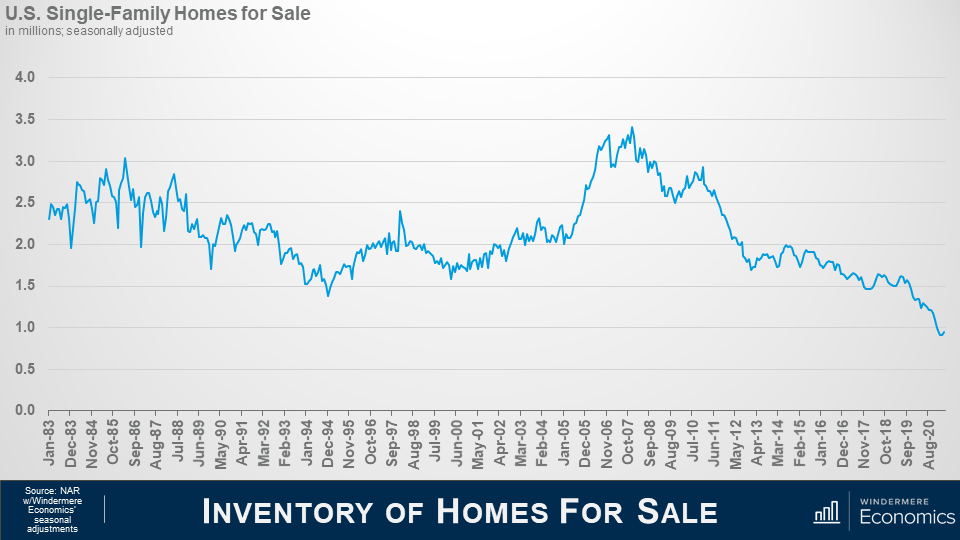
The chart below shows the number of single-family homes for sale going back to 1983. As you can clearly see, there’s never been a time — at least since records were kept at the national level — where they were fewer homes for sale at any one time.
And this is a problem because the biggest issue the market faces today is that demand for homes is far exceeding supply.
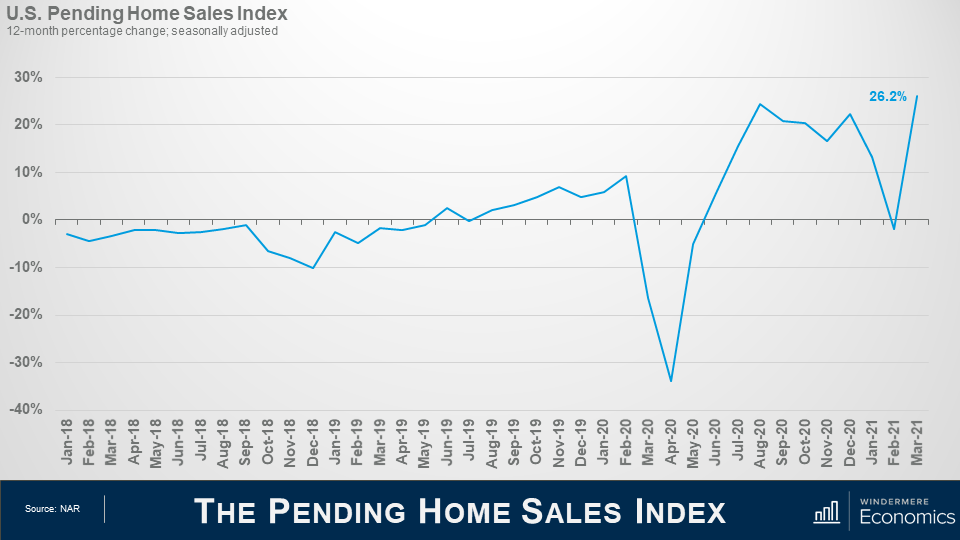
A report I track very carefully — and I am sure that many of you do, too — is the National Association of Realtors pending home sales index, which is shown below.
Although it’s not a perfect indicator, as the survey only covers about 20 percent of all homes that go pending, it does give us a pretty good idea as to what the future may hold given that, all things being equal, about 80 percent of pending homes close within roughly two months, making it a leading indicator.
You can clearly see the massive pull back last spring because of the pandemic, but this was very quickly followed by a very significant surge.
It pulled back again last winter, but I would suggest that this was more a function of lack of homes for sale than anything else. However, look at the March spike.
Now, you might be thinking that this is a great number, but I would caution all of you not to pay too much attention to year-over-year changes, as they can be deceiving. You see, the index jumped because it was being compared with last March when the pandemic really started.
Closed sales
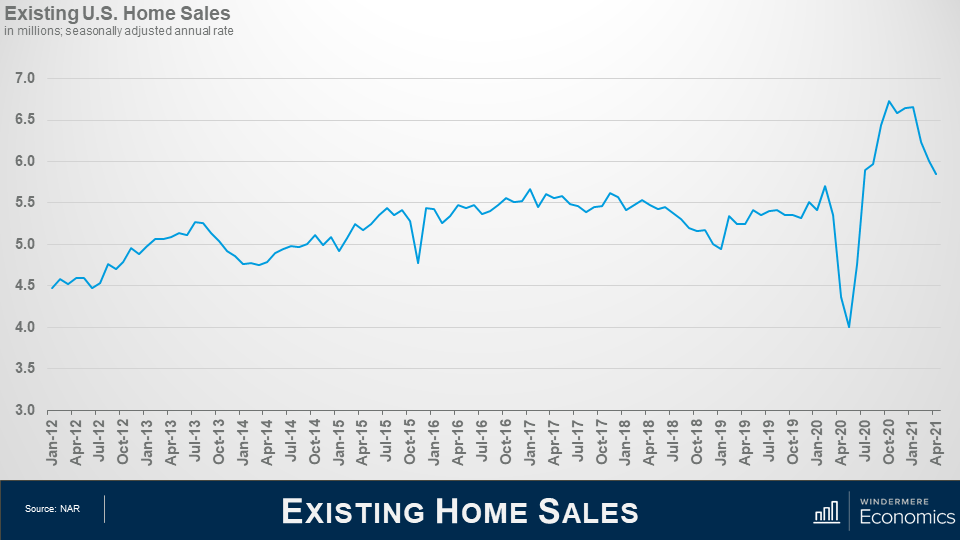
When we look at closed sales activity, it actually lines up pretty well with the pending home sales index, which fell in January and February. This is reflected in the contraction in closed sales that we saw this spring. And if the index is accurate, it suggests we may see closed sales activity pick up again over the next couple of months.
Of course, any time where housing demand exceeds supply, there is a solution — and that would be to build more homes.
But as you can see here, though more homes started to be built as we emerged from the financial crisis, the number today is essentially the same as it was two decades ago and has been declining for the past two years.
That’s significant, as the country has added over 12 million new households during the same period which has further fueled demand for housing. If there are no new homes to buy, well, that does one thing — and that’s to put more focus on the resale market, which has already led to very significant price increases.
New home market
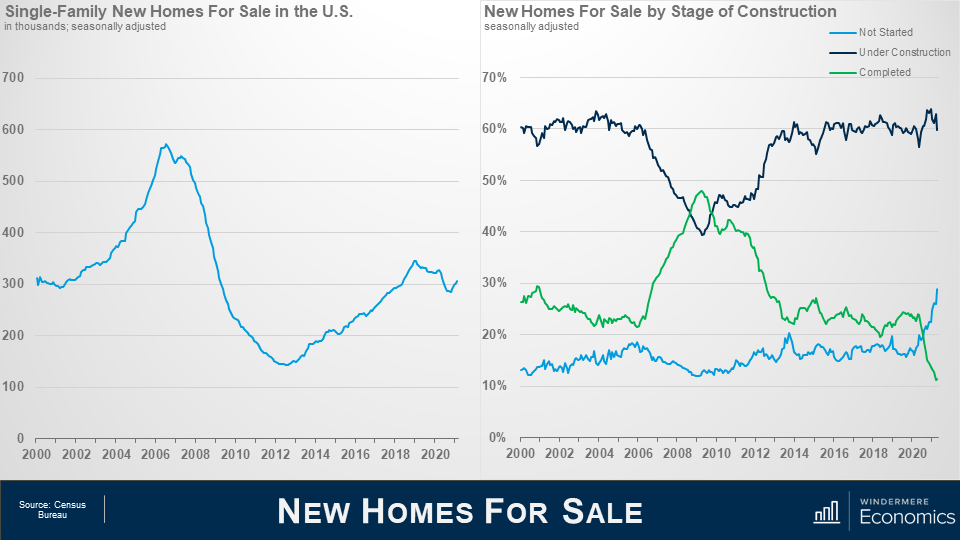
But this particular report also offers some additional data sets, which I think give more clarity to the state of the new home market.
Before the housing market crashed, you can see that a majority of new homes that were on the market for sale were being built at that time, but — as the housing bubble was bursting — the market dropped, and the share of homes that were finished and for sale naturally rose.
But what I want you to look at is the far right of the chart above. You see the spike in the share of homes for sale that have not yet been started?
Well, given the massive increase in construction costs builders have, understandably, become far more cautious and are trying to sell more homes before they start to build them to mitigate some of the risk. It also tells me that they see demand that is not being met by the existing-home market and are looking to take it advantage of this.
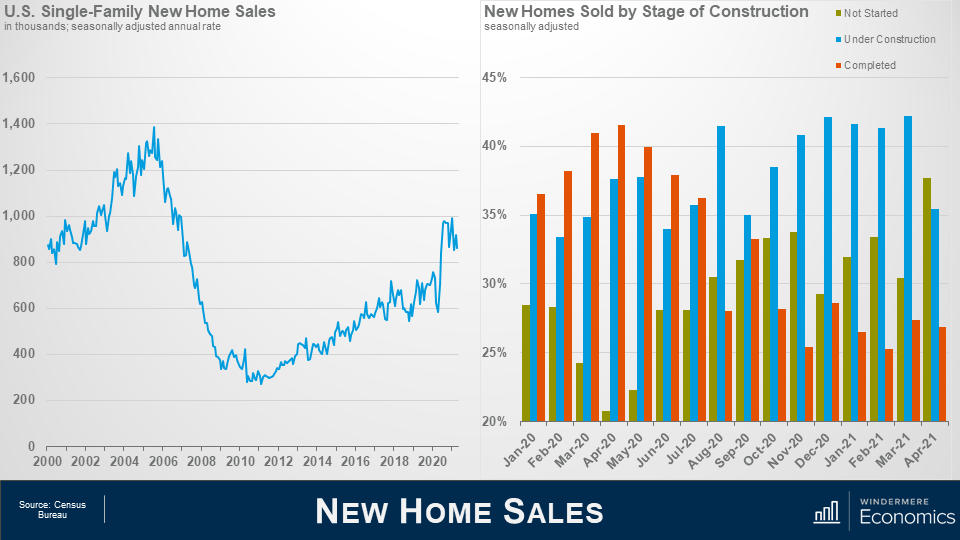
When we look at new home sales, you can see that the trend, in essence, follows the number of homes for sale, but I would caution you on a couple of things.
Firstly, these figures do not represent closed sales, as the Census Bureau, which prepares this dataset, considers a home sold once it has gone under contract. This makes sense, as a home can be sold before it has even broken ground. In essence, it’s more similar to NAR’s Pending Home Sales Index than anything else.
Look now at sales by stage of construction on the right. You can see that, as the pandemic was getting started, new homes that were ready to move into were what buyers wanted, and that accounted for over 42 percent of total new sales in April.
As the supply of finished homes dropped, homes that were being built took the lion’s share of sales — as they have done historically. However, look at April. The greatest share of sales — 37.7 percent — were homes that hadn’t yet been started.
Again, this supports the theory that builders remain cautious given ever-escalating costs, but it also shows that buyers’ needs are not being met by the resale market, so they were willing to wait, likely a considerable time, for their new home to be built.
Of course, the couple of datasets I’ve shared with you today are just the tip of the iceberg when it comes to the housing-related numbers you should all be tracking, as they can tell a story that can impact everyone involved in the development or sale of homes.
Mortgage rates
In addition to the data we have discussed today, you should be well versed in mortgage rate trends, demographic shifts, building permit activity and the economy in general — and you need to understand all these numbers at a local as well as national level.
For the vast majority of households, buying a home will be the most expensive thing that they will ever purchase in their lives. And given memories of the housing crash, as well as the significant increase in home prices that we’ve seen since last summer, it’s now more important than ever for you to be able to share your knowledge with your clients and be able to advise them accordingly.
Windermere’s Chief Economist, Matthew Gardner, often contributes to local and national publications with his insights to the housing market. Recently he offered his analysis of home sales numbers to Inman News, this is a repost of that video and article.
As the ubiquity of working from home continues, many homeowners are making the decision to move. Whether the motivation for relocating is to lower the cost of living, to be closer to family, or simply a fresh start, there are various factors to keep in mind when relocating for remote work.
Before You Relocate
Before you make the jump to a new life in a new place, making time for some strategic planning will help ensure your relocation goes as smoothly as possible. A logical first step is to consider the financial impact of your move. Depending on your company’s policy, there may be adjustments to your pay when you relocate. If this is the case, factor in your pay change as you form your relocation budget. Research the cost of living in your new hometown to understand how a compensation adjustment may affect your home search and your lifestyle once you move.
If you are moving out of state, relocating could affect your benefits and your taxes as well. There’s a chance that your employer’s health insurance plan does not offer coverage in the state you’re moving to. Talk to your employer to discuss your options. Before moving out-of-state, find out whether the two states have a reciprocal tax agreement, especially if you’re moving between states that have differing income tax regulations.
Your New Home for Remote Work
Working remote has given homeowners the freedom to choose their desired location, unbound by a work commute, especially if their company has indicated that there are no clear signs of returning to in-person work anytime soon. Knowing your desired work environment will help to tailor your home search. If you’re looking for peace and quiet while you work, explore listings in rural areas. If the hubbub of city life is your idea of a comforting backdrop, direct your attention to metropolitan areas.
For the remote worker, it’s more important than ever that your home accommodates your working needs. As many homeowners have experienced throughout the pandemic, you spend a great deal of time in your home office, so finding the home with the best workspace for you should be a priority. If you desire a private area where you can focus, a home with an open floor plan may not be the best choice. Instead, you may want to look for homes with a separate bonus room or extra bedroom.
Once you’ve moved into your new home, it’s time to put together your home office. Whether your previous home office was a professionally curated environment or a makeshift workspace in the corner of a room, a new home means a fresh start for your remote work. Like many homeowners, by now you’ve likely got a solid grasp on what your ideal home office looks like. Keep those elements alive when you relocate and enjoy productive workdays in your new home.
For pet owners, it’s hard to imagine their home without a furry friend. However, when it comes time to sell, showcasing the qualities of a home should take precedence over the pets that live in it. This creates additional steps in the process of preparing your home for sale, but it makes all the difference in the minds of buyers.
Staging Your Home
A well-staged home makes it appealing to the widest variety of buyers and has significant ROI potential when it hits the market. However, having a pet can complicate the staging process. Buyers may lose interest in the home if they see traces of pets, so it’s a good idea to hide any and all signs of their presence.
It’s especially important to hide evidence of your pet in marketing photos. Prepare for your home’s listing photos by cleaning and vacuuming, making sure all pet stains are gone and any pet-related damage is repaired. Stow any pet carriers, cages, toys, food bowls, and other supplies that may hinder the photographer’s ability to capture the essence of a room.
Showing Your Home
Before inviting potential buyers inside, it’s best to give your home a deep clean to improve your home’s air quality, and to rid your carpets, flooring, and surfaces of pet odors and any dirt they may have tracked in over time. If you’re using your own furniture, vacuum and clean everything to extract as much fur and pet dander as possible. Talk to your agent to see if it’s a better idea to stage your home with rented furniture. If your pets have caused any damage in the home, make repairs or replacements as needed. After tending to your home’s interior, don’t forget to clean up after your pets in your yard as well. Fill in any holes in the lawn, freshen up your flower beds, and tidy up any areas of the landscaping where your pets may have dug.
After you’ve prepared your home for showings, there’s the question of what to do with your pets once buyers actually start taking tours. Ask a family member, friend, pet sitter, or neighbor to watch your pets while the showings take place. If you’re not able to find someone to watch them, form a strategy to temporarily relocate your pets during showings. If they must stay in the home, garage, or backyard during tours, it’s best to give buyers advanced notice that there are pets on the property. Talk to your agent about posting signage communicating their presence so that there are no surprises as guests make their way through the house.
Taking all these precautions will help to present your home in the best light without detracting certain buyers, for whom the signs of a pet may cause them to lose interest. On the other hand, if any buyers inquire about how the home can accommodate their pet, you and your agent will be more than ready to answer any questions they may have.
Selling Your Home
For more information on the process of selling your home, visit the Selling Page on our blog. To get an idea of what your home is worth, try our free home value calculator below:
So many projects, so little time. That tends to be the mantra for homeowners with an ever-growing to-do list and limited availability to accomplish their tasks. Fortunately, the weekend is an opportunity to dig into certain projects and see them to their completion by the time the weekdays come around again. These seven weekend home projects can be accomplished within a couple of days and will make a dent in your to-do list.
1. Upgrade Your Kitchen Cabinets
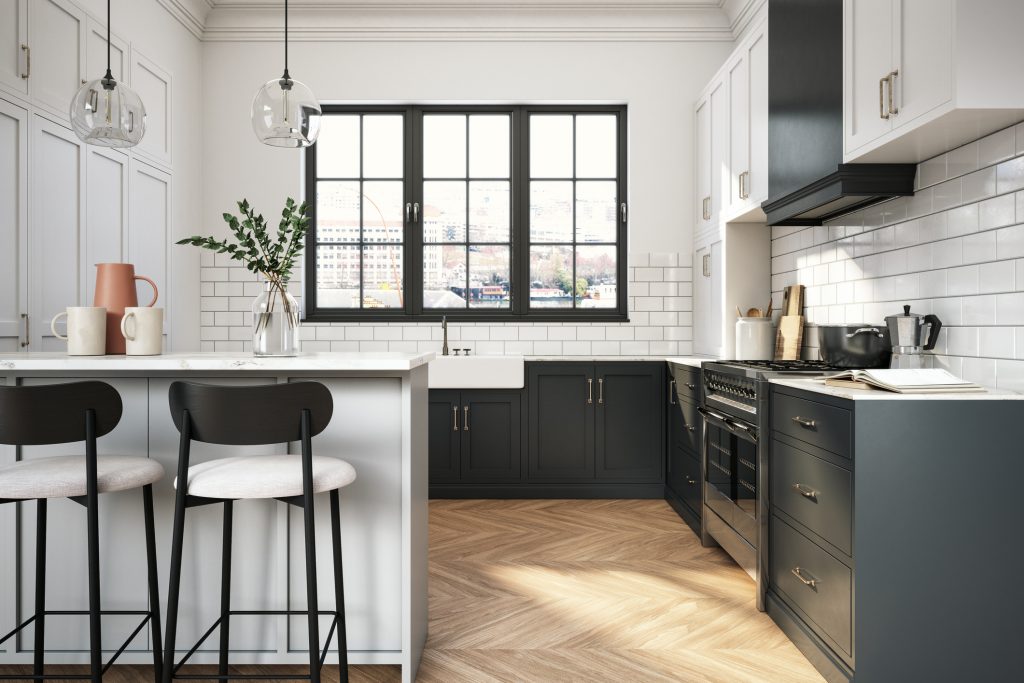
Giving your kitchen cabinets a facelift is a simple way to give your kitchen a makeover. When staining wood cabinets, begin by removing the cabinet doors and hardware, then wipe the doors to clear away and dust and dirt. After applying and removing wood stripper, sand the doors to get them primed and ready for a new stain. When painting cabinets, choose a color that works well with your appliances. As you pack up the contents of the cabinets keep your most frequently used items nearby so you can access them during your project. To add a finishing touch to your weekend cabinet makeover, shop around for new hardware and drawer inserts.
Image Source: Getty Images
2. Refresh Your Front Entry
Your home’s front entry is the key to making a lasting first impression and helps to enhance your curb appeal. Make a statement by giving your front door a fresh coat of boldly colored paint, look for stylish house numbers, and add classic front entry elements like a sitting bench or swing for ultimate comfort.
3. Improve Your Home Office
Whether you work remotely or in person, much can be done in a weekend to improve the functionality of your home office. Creating an environment conducive to your productivity helps to separate your office from the rest of your home, maintaining a balance between your work life and your home life. Situate your desk near a window to attract natural light. If the room has no windows, orient your seating so you’re facing the open space of the room. Experiment with therapy lights, ergonomic chairs, and soothing décor to make your office as comfortable as can be.
4. Curate Your Bathroom
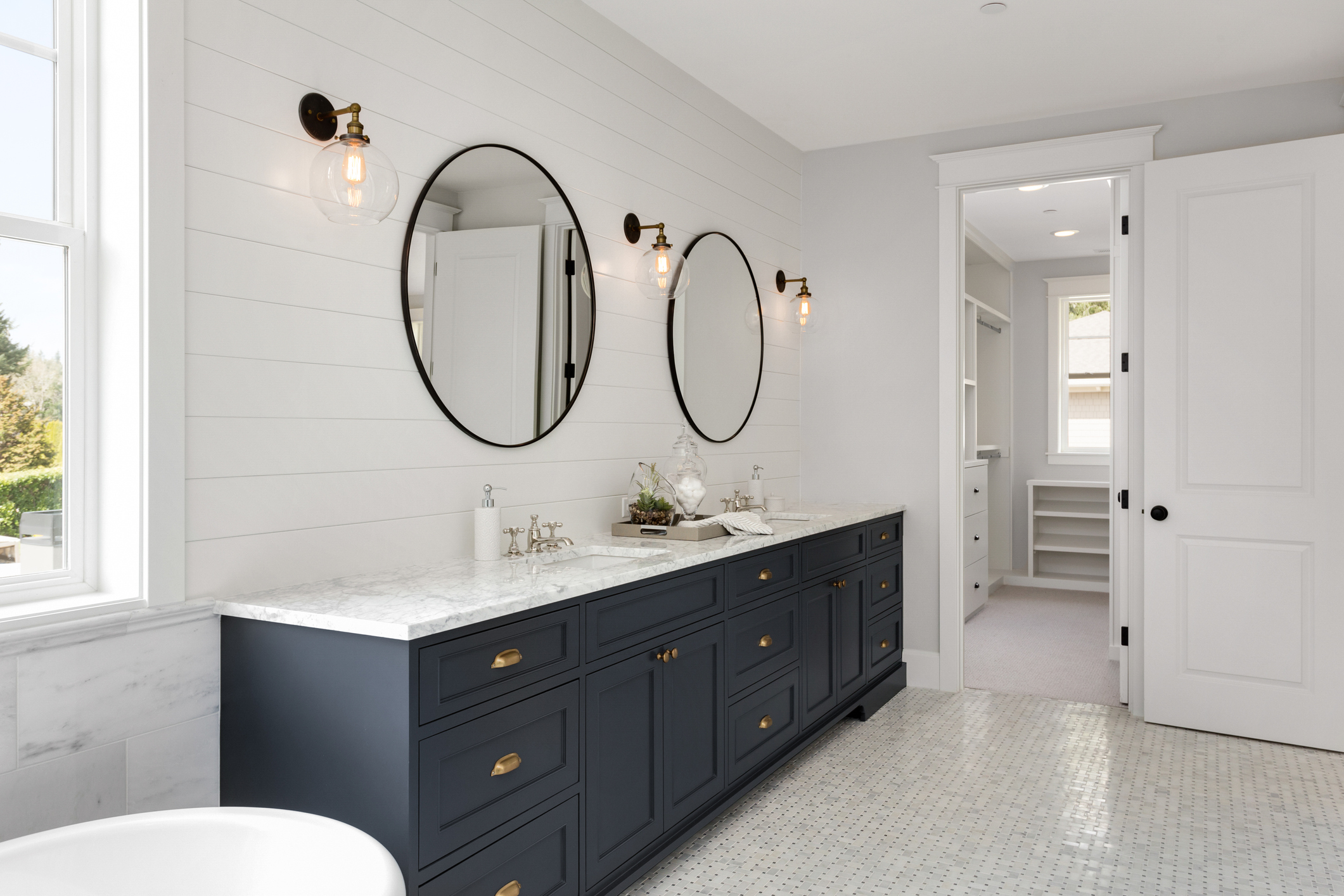
In one weekend your bathroom can be transformed into a sanctuary of self-care. Refinishing your tub is a cost-effective alternative to a replacement. Start by removing any and all hardware, then sand the whole surface, filling in any cracks or holes with putty. Once you’ve sanded down the putty, apply multiple layers of primer and topcoat following the manufacturer’s instructions and buff the surface. Replace your vanity’s cabinet hardware and drawer pulls, matching them with your shower rod, faucet and shower head to tie the room together. Switch out your shower curtain and carpets for bold colors to liven up the space or choose neutral tones to create an organic feel.
Image Source: Getty Images
5. Organize Room-By-Room
Spending a weekend organizing each room of the house is sure to make a big difference in the look and feel of your home. Bookcases and coffee tables are magnets for clutter in the living room. Start by emptying everything and sort the items into three piles: keep, dispose, donate, (this method of organization will do wonders for your closets and bedroom as well), and invest in storage bins to keep the space tidy. In the bathroom, organize the medicine cabinet and vanity drawers first. Get rid of expired medication, makeup, and toiletries. Take the same approach to your shower. Once you’ve gone through everything, reassess your shower shelving to fit your newly organized inventory. After working your way through your kitchen cabinets, consider either a hanging or wall-mounted pot and pan rack to save space.
6. Fix Up Your Fence
Whether your fence needs a simple wash, a new sealant or stain, or repair, tending to it will freshen up your yard while also extending the life of your fence. Power washers are a helpful tool in getting your fence clean before re-staining, but a sprayer that’s too powerful could damage the wood. Let the fence dry for one to two days before applying the stain. As long as any damage that needs repair is contained to a section of the fence, a weekend should be plenty of time to get it fixed. To replace any damaged rails, pry them off their posts with a crowbar or cut the damaged section out with a handsaw. When repairing fence posts, be sure to remove any rails that are connected to it.
7. Build a Firepit
Common firepit materials include brick, stone, or cinder blocks. Outline your firepit before you start digging. Once the hole is dug six to eight inches deep, fill in the hole with gravel until it is level with the ground. Choose your materials, fix the stones into the ground, compact them together, and enjoy your time by the fire. Check for local burn bans or regulations.
336 Summit Ave. Fircrest, WA 98466 Selling Price: $713,000
4 Beds
3.25 Baths
2,904 SqFt
Year Built: 1945
Sitting on the summit in the city of Fircrest you have found a gem that features the owners suite on the main level & a studio apartment on the lower level w/2 separate entrances offering an amazing opportunity for additional income or just to keep everyone close! Great for multi-generational living! Offered for the 1st time on the market in 37yrs you will adore the original layout of this 1940’s home w/an addition & updates that add more living space. Real hardwood floors greet you & lead to island kitchen, living & vaulted family rooms with lots of daylight & privacy! Don’t miss the massive amounts of attic storage! Lower level offers a huge utility rm, attached 2 car garage & entrance to the studio apt. Quiet alley access, deck & more!
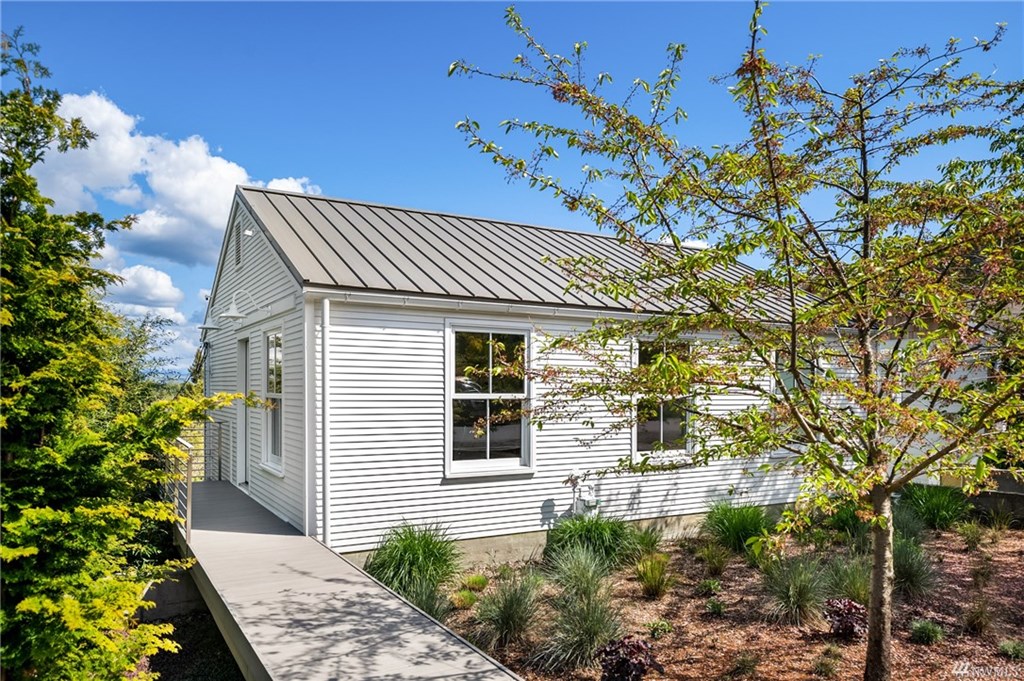
5432 34th Ave SW
Seattle, WA 98126 Selling Price: $799,950
3 Beds
1.75 Baths
1,440 SqFt
Year Built: 1947
Impeccably designed by owner architects, this reimagined 3 bed/1.75 bath home celebrates the spirit of NW architecture. No detail was spared in this studs-out renovation with hand-selected materials including reclaimed wood floors, Heath ceramic tile, custom cabinetry, high-end appliances, clear VG cedar siding, a 50-year metal roof, Marvin windows + so much more. Wake up to breathtaking sunrises and expansive mountain views and relax in your peaceful backyard with raised garden beds, an orchard & multiple gathering areas. Ample off-street parking with electric car charging station plus an oversized lot with DADU potential. Just steps to Camp Long, Longfellow Creek trails and central to both Alaska & Morgan Junctions. A true urban oasis!
When the housing market favors sellers, a seller can expect ideal conditions for selling their home. However, that’s not to say that a seller’s market doesn’t come with its own unique set of challenges for parties on both sides of the transaction. That’s why it’s critical for buyers and sellers to work with an agent who not only understands their wants and needs but who can also help them navigate highly competitive market conditions.
What is a Seller’s Market?
A seller’s market occurs when demand exceeds supply. When inventory is limited, competition amongst buyers is fierce. Median sales prices increase, days on market decrease, and homes commonly receive multiple offers, often over their original asking price.
Selling in a Seller’s Market
Though demand is high in a seller’s market, staging and making any necessary repairs are still important steps to take before hitting the market. An agent can help a seller make important decisions about which repairs and updates help add value to the home.
When it comes to offers and negotiations in a seller’s market, sellers have the leverage. It’s common for homes to fetch more than their asking price with multiple offers on the table. Though prices are being driven up by demand, a seller may choose to list their home at or just below fair market value with the hopes of starting a bidding war. Because competition is so high, buyers may be willing to waive an inspection contingency to help make their offer stand out. Agents can help sellers decide whether they should conduct a pre-listing inspection, which sometimes helps the seller get more offers and command a higher price.
With multiple offers on the table, it may be tempting to simply choose the one with the highest figure; however, the best offer is also the one that removes risk and aligns with the seller’s goals. Whether that entails waived contingencies, a shorter closing window, or an all-cash offer, in a seller’s market, the seller has the power to choose. Sellers should fully review each offer with the help of their agent before proceeding.
Buying in a Seller’s Market
Buyers in a seller’s market must act fast. Due to the high level of competition, they must be prepared for a frustrating scenario where their offers may not win out. This emphasizes the importance of working with a buyer’s agent. In a seller’s market, it’s more likely that the buying process will include such factors as seller review dates and escalation clauses. A buyer’s agent will help navigate these challenges while working with their client to make their offer stand out. They will formulate a strategy, comparing their client’s wish list and budget against the limited number of homes available and proceeding accordingly. A buyer’s agent will also set the expectation that, due to the competitive nature of the market, finding the right home may take longer than expected.
In a seller’s market, the buyer is at a disadvantage when it comes to negotiations. The chance of getting a contingent offer is minimal and pushing for certain closing dates and specific repairs may do more harm than good to their offer. A cash offer has significant power in a seller’s market. If a buyer can make a cash-heavy or even all-cash offer, it is likely to stand out to the seller. It gives the buyer more buying power and greatly increases their chances of winning a bidding war.
For more information on the conditions of your local market, visit our website for Quarterly Real Estate Market Updates from our Chief Economist, Matthew Gardner. For assistance planning a home sale or purchase, please feel free to contact me.

 Facebook
 X
X
 Pinterest
 Copy Link

















 5432 34th Ave SW